Reed College · B.A. Mathematics · Math 243 · Statistics · 2020 · Team of three
The MLB Luxury Tax and the Players It Left Behind
A statistical-inference project testing whether MLB's 2003 competitive-balance tax raised the rate of "couldabeens" — players who retired while still outperforming the average rookie — while controlling for the Moneyball revolution.
Collaborators: Grant Dunlavey, William Ren
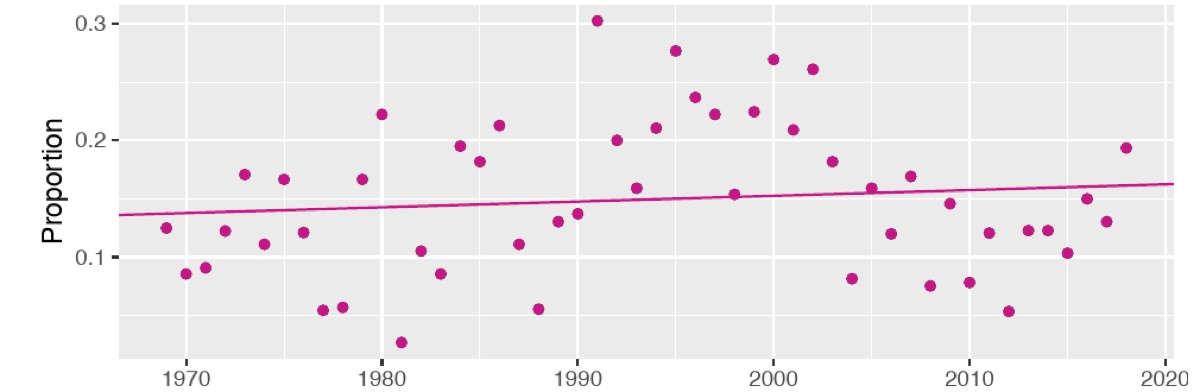
In 2003 Major League Baseball introduced a competitive-balance (“luxury”) tax to rein in team payrolls. We asked whether it carried an unintended cost: did it push still-capable players into early retirement? We define a “couldabeen” as a player who retired in a season when he was still outperforming the average rookie — measured by Wins Above Replacement — and tracked the yearly proportion of such retirements across roughly fifty seasons.
The real difficulty is confounding. 2003 also sits at the dawn of the Moneyball era, when sharper player evaluation independently reshaped who stayed in the league. We separated the two effects by partitioning the data into pre- and post-Moneyball eras and running a hypothesis test on the difference in means (≈0.16 vs ≈0.12, p ≈ 0.045), so the tax’s effect could be read against the Moneyball baseline rather than mistaken for it.
Built in R. A three-person team project — and my first real exercise in defending a causal claim against an obvious alternative explanation.