Climate and the Evolution of Complex Tone
A graduate statistics project testing — and extending — the hypothesis that ambient humidity predicts where complex tonal languages emerge, joining 527 languages to 75 years of global climate data.
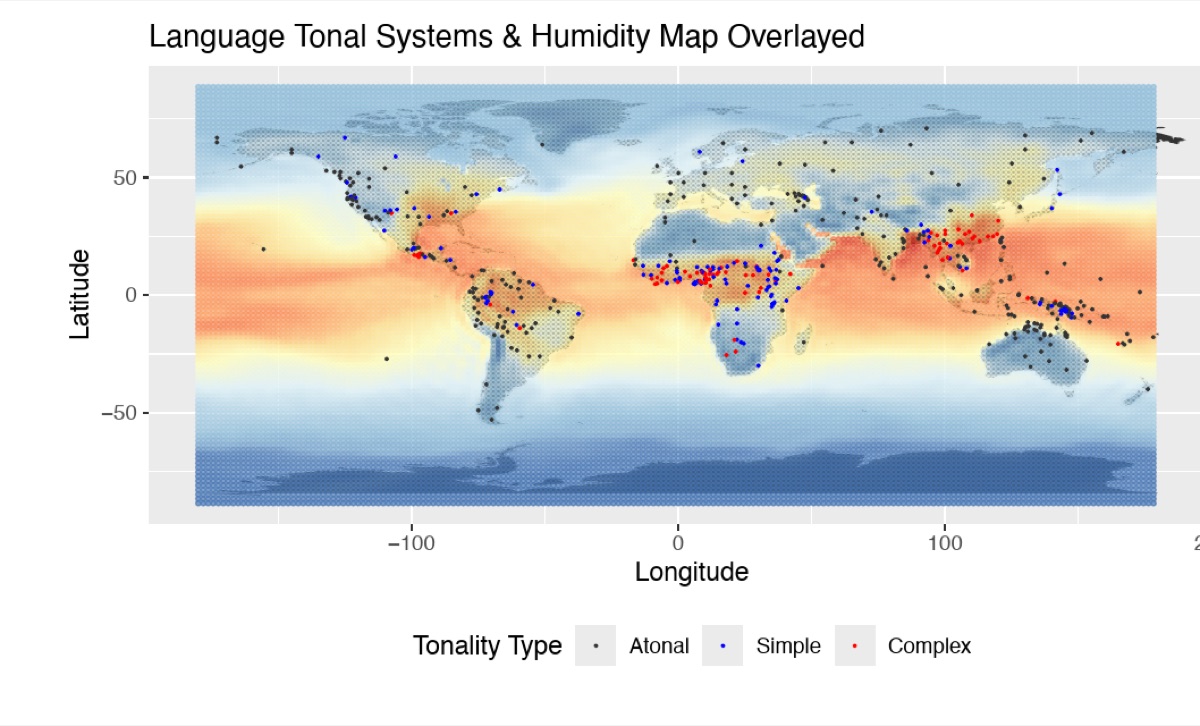
Why are tonal languages — where pitch alone can change a word’s meaning — common in the humid tropics but rare in dry climates? This project recreates and extends Everett & Moran’s (2015) hypothesis that arid air, which makes precise control of vocal pitch harder, suppresses the emergence of complex tone.
I joined the World Atlas of Linguistic Structures (527 languages) to 75 years of global humidity data from the American Meteorological Society — roughly 16 million rows — using a nearest-coordinate match to attach a climate profile to every language. On top of the original analysis I tested whether the upper quantiles of humidity predict complex tonality better than the mean (they do), fit logistic GLMs on those predictors, and built survival-style models showing how tonality “drops out” as climates dry.
The honest wrinkle: a handful of language families cut against the climate signal — a reminder that phylogeny and culture confound a purely ecological story. A solo project, and the one where I spent the most time turning messy, mismatched sources into a single clean modeling table.